
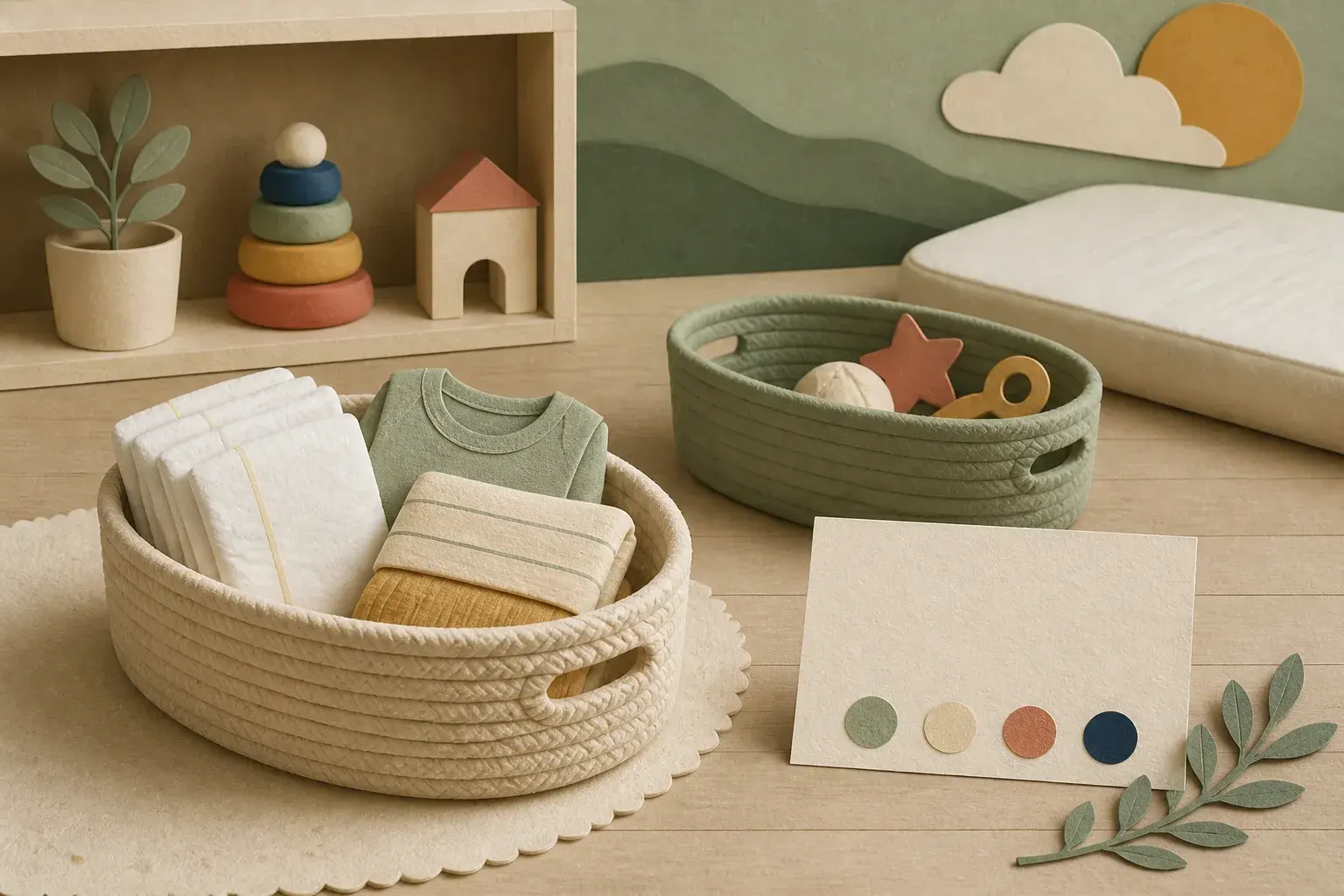
The registry is not a test
A newborn needs a safe place to sleep, basic care supplies, appropriate clothes, feeding support that matches the plan, and safe transport home. Many other products can wait.
Use your home, budget, season, care plan, and local guidance as filters instead of trying to recreate a universal nursery.
Three columns for a calmer list
Sort every item into must-have, useful soon, or later. A later item can be borrowed, bought after you understand your baby’s routine, or skipped.
- Must-have: safety and basic care.
- Useful soon: items that remove a repeatable friction point.
- Later: duplicates, novelty items, and products with no clear job yet.
Ask what the item changes
For every purchase, ask what task it makes safer, easier, or more comfortable. If the answer is only that a registry says you should own it, leave it on the later list.
Revisit the list after the first week; real life will show what is missing more accurately than a large shopping cart.
Use the later column as a decision tool
The later column protects both money and attention. Put items there when you do not yet know the baby’s size, routine, feeding needs, storage situation, or whether the product solves a real problem. Waiting is often better information than guessing.
Ask whether the item changes safety, basic care, or a repeated friction point. If it only makes a nursery look complete, it can probably wait. If it creates a safer sleep setup or makes a necessary care job possible, it belongs in the first group.
Borrowing can be useful for short-lived stages, but check safety, condition, instructions, and local guidance before using second-hand equipment. Some products are not appropriate to reuse or modify, and the care team can help with questions.
Review the later list after the first week and again after the first month. Keep only what the household can explain, use, clean, and store. A shorter list that supports the real routine is a successful list.
- Put uncertain items in later, not urgent.
- Give each purchase a specific safety or care job.
- Check second-hand items carefully.
- Review the list after real use.
- Skip products that add more maintenance than value.
Sort by the first week’s real jobs
For each item, name the first-week job it supports: sleep, changing, feeding support, transport, adult recovery, or household reset. If it has no first-week job, move it to later and leave the decision open.
This method also reveals duplicates. Two items may solve the same job while only one is easy to clean, store, and reach. Choose the version that reduces work rather than the version with the longest feature list.
Keep the later list visible but not urgent. Revisit it after the family has learned the baby’s routine and the care team has answered individual questions. A delayed purchase can be a more informed purchase.
- Name the first-week job for every item.
- Remove duplicate solutions.
- Choose ease of use over feature count.
- Keep later items visible but non-urgent.
- Revisit after real routine and professional guidance.
Make later a deliberate category
The later column is not a failure to prepare. It is a decision to wait for better information. Put an item there when its job is unclear, the household already has a substitute, the baby’s routine will determine the fit, or the product would add more storage than relief.
Keep the later list visible but non-urgent. After the first week, review what the adults reached for repeatedly, what was awkward to clean or store, and what the care team said about the individual plan. Real use is stronger evidence than registry pressure.
When you do buy, choose one solution for one job and remove the duplicate from the list. A smaller system is easier to reset, easier to share, and less likely to turn preparation into a source of anxiety.
- Move unclear or duplicate items to later.
- Review the list after real routines begin.
- Use professional guidance for individual needs.
- Buy one clear solution for one clear job.
SPECIFIC SHORTLIST
Specific gifts to compare
Each card names the item, who it suits, its job, and the trade-off. Price and availability are snapshots checked 2026-09-06; confirm the current listing before buying.
HYDRATION · ~$30
Owala FreeSip 24 oz
An insulated stainless-steel bottle with a leak-proof flip lid and sip-or-swig spout.
- Best for
- A dad carrying water through feeds, commutes, and stroller walks.
- Use it for
- Leave it by the changing station or carry it through an overnight shift when an open cup is impractical.
- Why it made the list
- The 24 oz size and carry loop make hydration easy to repeat without adding a bulky bottle to the household.
- Trade-off
- The cup is hand-wash recommended and the stainless model is intended for water, not hot, carbonated, or perishable drinks.
- Budget
- US$29.99 before tax and shipping
Snapshot checked 2026-09-06
CHARGING · ~$22–26
Anker 313 Power Bank (PowerCore 10K)
A slim 10,000mAh portable charger for a phone, earbuds, or other USB-powered devices.
- Best for
- A dad moving between the bedroom, car, hospital, and work.
- Use it for
- Top up a phone during a hospital day or a late-night handoff away from an outlet.
- Why it made the list
- It solves a repeatable low-battery problem in a pocketable form and is easier to use than a multi-device charging station.
- Trade-off
- This older model's USB-C port is input-only, and the cable and wall adapter are not included.
- Budget
- US$21.99–25.99 before tax and shipping
Snapshot checked 2026-09-06
CARRY · ~$35
Herschel Chapter Travel Kit — 5L
A soft organizer with a waterproof zipper, front pocket, mesh sleeve, and side handle.
- Best for
- A dad who needs one small home for chargers, toiletries, or a change-of-clothes kit.
- Use it for
- Keep it packed for the hospital bag, office commute, or first overnight away from home.
- Why it made the list
- The 5L shape separates small essentials without asking the recipient to adopt a whole new bag system.
- Trade-off
- It is an organizer, not a diaper bag, and the brand listing may show different availability by color.
- Budget
- US$35 list price; color-specific sales and stock vary
Snapshot checked 2026-09-06
MEMORY · ~$22–26
Moleskine Classic Notebook Hard Cover — Pocket
A pocket-size ruled or plain hardcover notebook for appointment questions, handoffs, or one line from the first year.
- Best for
- A dad who already carries a notebook or prefers analog reminders.
- Use it for
- Write the next care-team question, a handoff note, or one sentence from the first week.
- Why it made the list
- The pocket format, elastic closure, ribbon bookmark, and back pocket make it easy to pick up mid-routine.
- Trade-off
- Paper is not a shared live system, and the price changes by size, layout, shipping, and personalization.
- Budget
- US$22–26 depending on size and layout
Snapshot checked 2026-09-06
No Amazon Associate tag is configured here, so the Amazon links above are ordinary links. Read the affiliate disclosure.
QUICK ANSWERS
Questions new dads ask
What baby items can wait until after birth?
Many duplicates, decorative items, specialized gadgets, and products without a clear routine can wait. Start with safe sleep, changing, basic clothes, feeding support, and safe transport.
How do I make a baby registry less overwhelming?
Use three columns—must-have, useful soon, later—and give every item a specific job. Revisit the list after the first week.
SOURCES
Read the primary guidance
Health and safety notes are summaries for general education. Follow your own care team’s advice.
Edited by the newdadatlas editorial desk. We write for general education and link to primary guidance; when a question is personal, urgent, or medical, contact a qualified professional.