
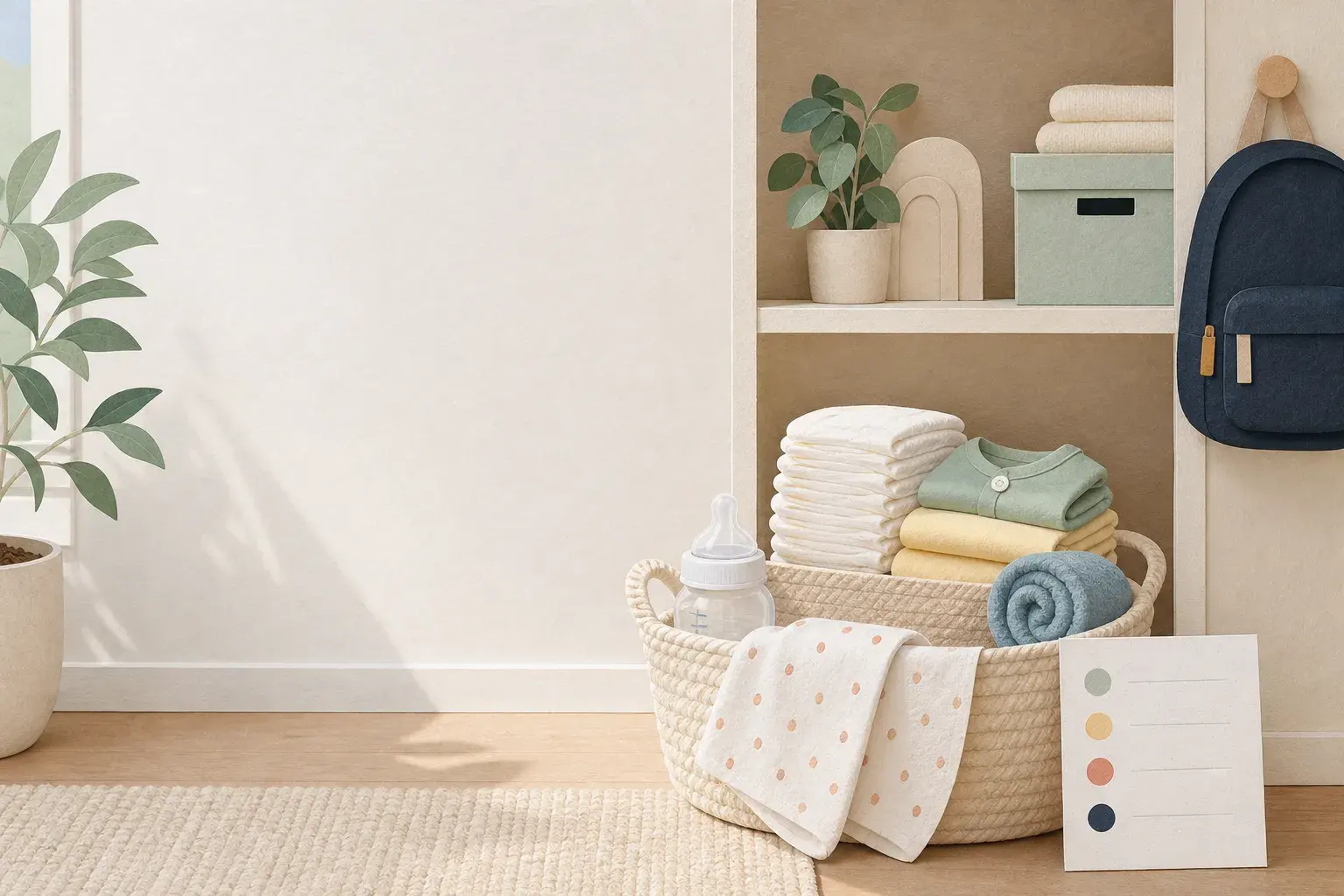
Prepare for the first 72 hours
A newborn does not need a perfect nursery. The first useful setup is a safe sleep space, a place to change the baby, feeding support that matches your plan, clothes that fit the season, and a way to get home safely.
Use the downloadable checklist below as a conversation starter with your maternity and pediatric care teams.
Must-have, nice-to-have, later
Separate the list into three columns. Must-have protects safety and basic care. Nice-to-have reduces friction. Later is anything you can borrow, buy after learning your baby, or skip entirely.
- Sleep: an approved, firm, flat sleep surface and fitted sheet.
- Change: diapers, wipes or washcloths, and a safe place to work.
- Travel: an appropriate rear-facing car seat and a route home.
- Adults: water, simple food, chargers, and a plan for rest.
Let the list stay flexible
Your care team, baby’s needs, home, budget, and local guidance matter more than a universal registry. Revisit the list after the first week; real life will tell you what is missing.
Turn the checklist into a shared setup
A checklist is most useful when every item gets a home and an owner. Put the safe sleep setup together, identify where changing supplies live, check the route home, and make sure the adults have food, water, chargers, and a plan for asking for help.
Separate universal safety basics from choices that depend on the family. Feeding equipment, clothing quantities, bathing supplies, and soothing tools can vary with the care plan, budget, home, climate, and advice from professionals.
Use the three-column method: must-have, useful soon, and later. The later column is not a failure or a shopping backlog. It gives the household permission to learn what the baby actually needs before buying more.
Review the list after the first week. If something was used repeatedly, make it easier to reach. If something was untouched, leave it alone. Real routines are better evidence than a registry template.
- Give every must-have a home.
- Assign each setup task to an adult.
- Keep feeding and medical choices with the care team.
- Separate must-have from useful soon and later.
- Revisit the list after the first week.
Do a final 30-minute readiness walk
Walk from the front door to the sleep space, changing area, and adult rest area. Check that the route is clear, supplies are reachable, the safe sleep surface is ready, and the person who will do the next task knows where everything lives.
Keep a short paper list for the last gaps rather than reopening every registry category. Focus on safety, basic care, transport, food, water, chargers, and contact information.
Tell helpers what not to bring or change. A calm household may need fewer products and more food, quiet, laundry help, or a person willing to follow the family’s care plan.
- Walk the route from the door to the care spaces.
- Check the safe sleep setup in place.
- Keep the last shopping list short.
- Tell helpers what support is actually useful.
- Follow local and care-team guidance over registry pressure.
Check the adult essentials too
A baby essentials checklist works better when it includes the adults who will use it. Put water, simple food, chargers, comfortable clothes, transport documents, and a way to ask for help beside the baby-care items. Protecting adult capacity makes the basic care plan easier to repeat.
Assign every setup task to an owner and give each item a home. One person can check the sleep space; another can reset changing supplies; a third helper can handle meals or errands. Ownership prevents the checklist from becoming another list one recovering adult has to manage.
Keep choices that depend on feeding, medical needs, climate, or the baby’s condition with the relevant care team. A general checklist can organize questions and supplies, but it cannot replace individual instructions.
- Add food, water, rest, and chargers to the list.
- Give each setup task one owner.
- Put frequently used supplies within easy reach.
- Separate general preparation from professional guidance.
TAKE IT WITH YOU
Use the interactive checklist
Save your progress on this device, open the article guidance for each item, or download a plain-text version to print and share.
SPECIFIC SHORTLIST
Specific gifts to compare
Each card names the item, who it suits, its job, and the trade-off. Price and availability are snapshots checked 2026-09-06; confirm the current listing before buying.
HYDRATION · ~$30
Owala FreeSip 24 oz
An insulated stainless-steel bottle with a leak-proof flip lid and sip-or-swig spout.
- Best for
- A dad carrying water through feeds, commutes, and stroller walks.
- Use it for
- Leave it by the changing station or carry it through an overnight shift when an open cup is impractical.
- Why it made the list
- The 24 oz size and carry loop make hydration easy to repeat without adding a bulky bottle to the household.
- Trade-off
- The cup is hand-wash recommended and the stainless model is intended for water, not hot, carbonated, or perishable drinks.
- Budget
- US$29.99 before tax and shipping
Snapshot checked 2026-09-06
CHARGING · ~$22–26
Anker 313 Power Bank (PowerCore 10K)
A slim 10,000mAh portable charger for a phone, earbuds, or other USB-powered devices.
- Best for
- A dad moving between the bedroom, car, hospital, and work.
- Use it for
- Top up a phone during a hospital day or a late-night handoff away from an outlet.
- Why it made the list
- It solves a repeatable low-battery problem in a pocketable form and is easier to use than a multi-device charging station.
- Trade-off
- This older model's USB-C port is input-only, and the cable and wall adapter are not included.
- Budget
- US$21.99–25.99 before tax and shipping
Snapshot checked 2026-09-06
CARRY · ~$35
Herschel Chapter Travel Kit — 5L
A soft organizer with a waterproof zipper, front pocket, mesh sleeve, and side handle.
- Best for
- A dad who needs one small home for chargers, toiletries, or a change-of-clothes kit.
- Use it for
- Keep it packed for the hospital bag, office commute, or first overnight away from home.
- Why it made the list
- The 5L shape separates small essentials without asking the recipient to adopt a whole new bag system.
- Trade-off
- It is an organizer, not a diaper bag, and the brand listing may show different availability by color.
- Budget
- US$35 list price; color-specific sales and stock vary
Snapshot checked 2026-09-06
MEMORY · ~$22–26
Moleskine Classic Notebook Hard Cover — Pocket
A pocket-size ruled or plain hardcover notebook for appointment questions, handoffs, or one line from the first year.
- Best for
- A dad who already carries a notebook or prefers analog reminders.
- Use it for
- Write the next care-team question, a handoff note, or one sentence from the first week.
- Why it made the list
- The pocket format, elastic closure, ribbon bookmark, and back pocket make it easy to pick up mid-routine.
- Trade-off
- Paper is not a shared live system, and the price changes by size, layout, shipping, and personalization.
- Budget
- US$22–26 depending on size and layout
Snapshot checked 2026-09-06
No Amazon Associate tag is configured here, so the Amazon links above are ordinary links. Read the affiliate disclosure.
QUICK ANSWERS
Questions new dads ask
What does a newborn actually need before birth?
A safe sleep space, basic changing supplies, clothes appropriate for the season, feeding support, and safe transport home are the foundation. Many other items can wait.
Do I need every item on a baby registry?
No. Use a short must-have list, then add items based on your baby, your home, and advice from the care team.
SOURCES
Read the primary guidance
Health and safety notes are summaries for general education. Follow your own care team’s advice.
Edited by the newdadatlas editorial desk. We write for general education and link to primary guidance; when a question is personal, urgent, or medical, contact a qualified professional.