
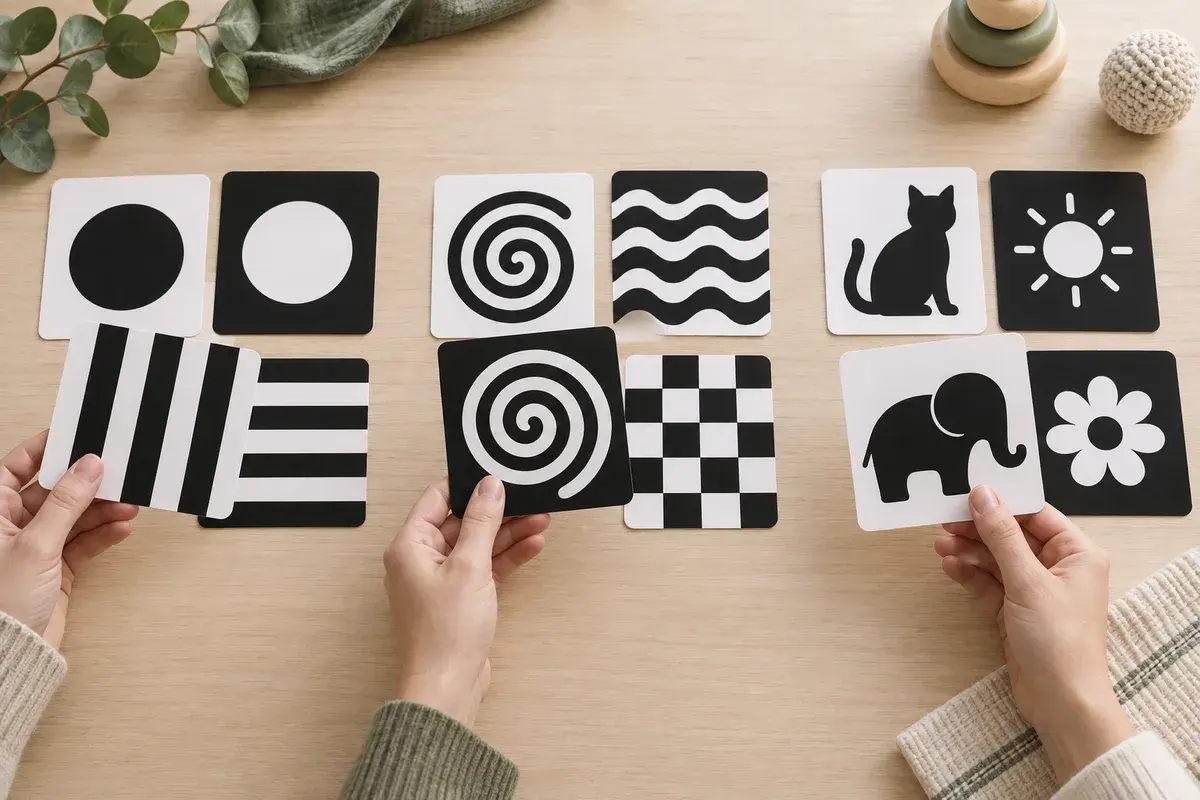
The quick age guide
There is no single perfect black-and-white card for every baby. A useful way to choose is to start with clear, simple shapes, add slow-tracking patterns when the baby is ready to watch movement, and then bring in animals, faces, and familiar objects as conversation starters.
These age ranges are practical suggestions, not developmental requirements. A baby may enjoy a spiral early, keep preferring a circle for months, or ignore every card in favor of a caregiver’s face. Follow the baby’s state and interest rather than trying to complete a progression.
- 0–2 months: large, simple geometry.
- 2–3 months: curves, spirals, waves, and slow tracking.
- 3–4 months: geometry plus simple faces and animal outlines.
- 4–6 months: animals, faces, nature, and familiar objects alongside favorite patterns.
0–2 months: start with large, simple geometry
In the early weeks, a card works best when its main shape is easy to find. Try a large circle, target, square, wide stripe, or a simple black shape on a white background. The point is not to make the card intellectually demanding; it is to offer a clear near object during a calm, awake moment.
Hold one card about 20–30 cm from the baby’s face and begin with stillness. Wait a few seconds before moving it. If the baby does not look, keep the card still or put it away. More cards and faster movement will not make the interaction more successful.
- Choose large shapes and wide lines.
- Use one card at a time.
- Start with a still card, then try only a small slow movement.
- Keep dense patterns for another day or a later stage.
FREE PRINTABLE RESOURCE
Build a small age-aware card set
Browse geometric, tracking, animal, face, and everyday-object patterns, then choose only a few cards that match your baby’s current interest.
2–3 months: add curves and gentle tracking
Around this period, some babies become more consistent at looking toward faces and nearby objects. AAP guidance notes that babies may begin following a moving object with their eyes by about 3 months. You can offer a spiral, wave, concentric circle, or repeated path as a reason to try a slow side-to-side movement.
Show the card still first, then move it from the middle toward one side and back. Keep the distance steady and the movement smooth. If the baby loses the card, return to the center or stop; the exercise is an invitation to look, not a route the baby must finish.
3–4 months: mix geometry with simple animals and faces
As the baby becomes more interested in faces, movement, and nearby objects, you can add simple animal silhouettes, large eyes, basic expressions, or one familiar item such as a ball or cup. Keep the background quiet and the outline bold. One animal per card is easier to talk about than a busy scene with tiny details.
Use short language while you show the card: “a cat,” “two eyes,” or “a round ball.” The baby does not need to name or identify the picture. The card is a shared focus for your voice and attention, not a flashcard test.
- Keep one main subject on the card.
- Pair the picture with a short, gentle phrase.
- Alternate a familiar geometric card with a new subject.
- Pause if the baby turns away, arches, yawns, or fusses.
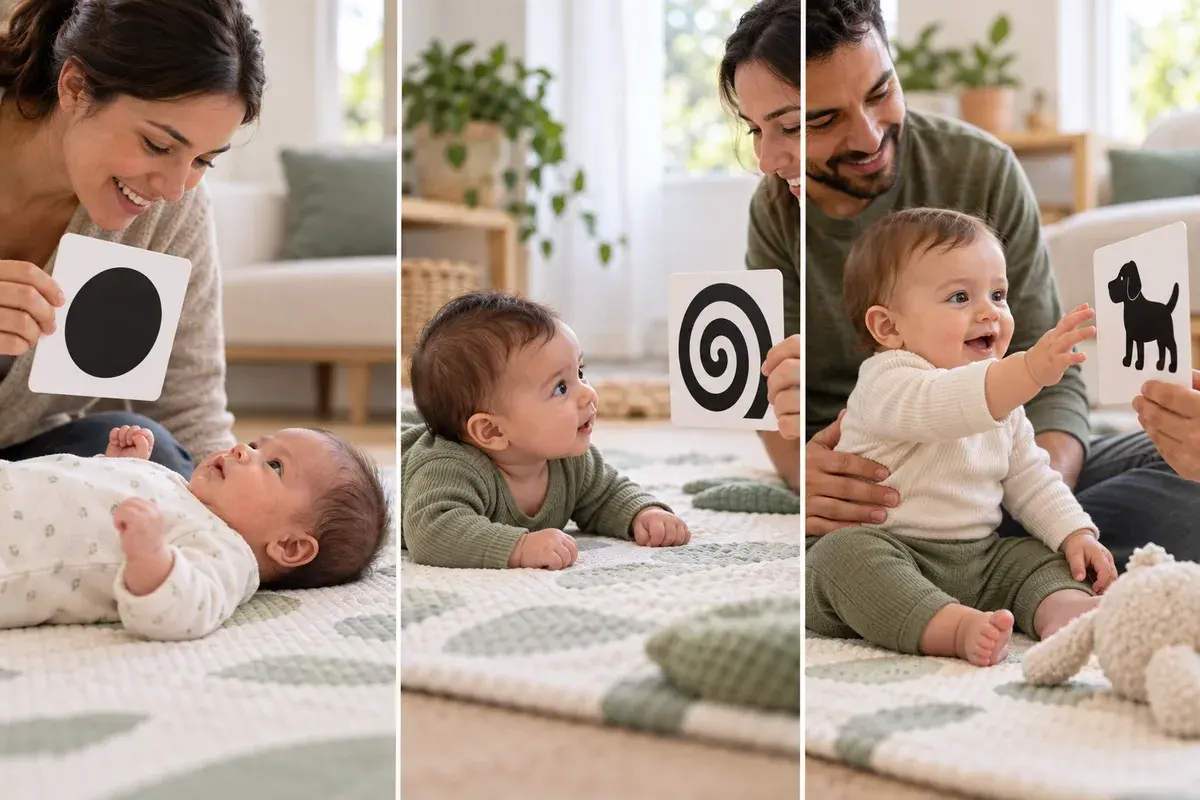
4–6 months: connect pictures with reaching and language
By about 4 months, babies are developing a broader visual range and may show more interest in colors, shades, and nearby objects. By 6 months, many babies reach for toys they want and explore objects with their mouths. That change makes animals, faces, nature patterns, and everyday objects useful conversation starters—but it also means loose paper cards need closer supervision.
Continue to keep favorite geometry and tracking cards in the rotation. Add a simple animal, leaf, sun, ball, spoon, or vehicle when it gives you something to point at and name. If the baby reaches for the card, let the adult control the distance and take it away before it becomes a paper object to pull or chew.
- Keep some bold geometric cards for familiar visual play.
- Add one clear animal, face, nature, or household object at a time.
- Use pointing and naming rather than asking the baby to perform.
- Use age-appropriate toys for grasping; use paper cards as adult-held visuals.
Four pattern families and when to try them
Geometry is the easiest foundation because you can control how much information is on the card. Tracking cards add a path for slow movement. Animal and face cards add language and social attention. Familiar objects and nature cards connect the picture to the world around the baby.
The categories overlap. A 5-month-old may still love a big circle, and a newborn may briefly notice an animal outline. Use the categories to organize your library, not to label what a baby should be able to do.
- Geometry: circles, squares, stripes, targets, and checkerboards for a simple base set.
- Tracking: spirals, waves, arcs, and repeated paths for slow movement.
- Animals and faces: one bold silhouette or face for observation and narration.
- Everyday objects and nature: balls, cups, leaves, suns, and other familiar outlines.
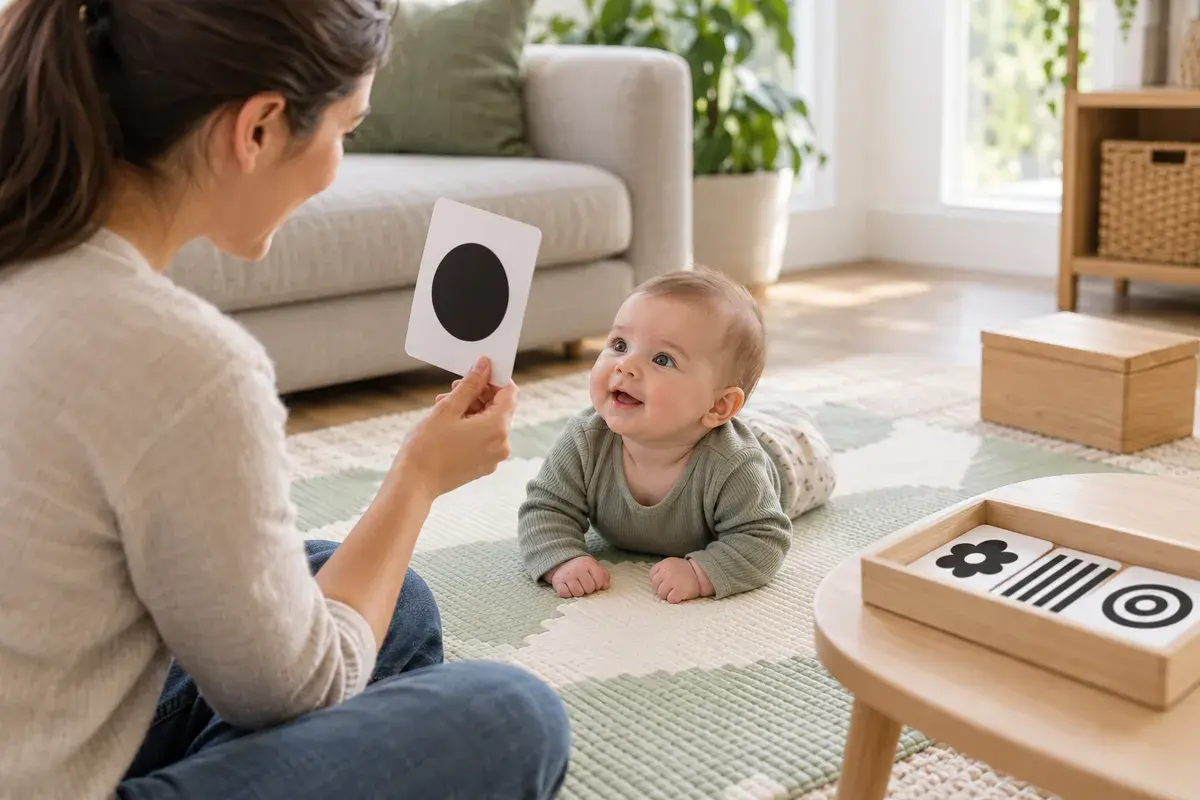
Build a small rotating set
A large library does not need to appear all at once. For 0–2 months, try two simple geometry cards and one stripe. For 2–3 months, add one spiral or wave. For 3–4 months, add one animal or face. For 4–6 months, add two or three familiar objects while keeping one card the baby already knows.
A small set makes it easier to notice what the baby actually enjoys and keeps spare paper out of the activity area. Store the rest in a box or drawer, and bring out only the cards you plan to hold during that session.
- Begin with 2–4 cards rather than the whole library.
- Keep one familiar favorite in the rotation.
- Add one new pattern at a time.
- Remove a card when its edge tears or the baby tries to mouth it.
Use the baby’s cues, not the calendar
A baby who is interested may look toward the card, stay relaxed, make a sound, or briefly follow the movement. A baby who needs a break may look away, yawn, blink repeatedly, arch, stiffen, fuss, or close their eyes. Those signals matter more than whether the card was labeled for the current month.
Black-and-white cards are not a vision screening tool, a measure of intelligence, or a promise of earlier development. CDC milestone resources are designed for observation and conversations with a child’s clinician, not as a replacement for standardized screening. If you have an ongoing concern about how your baby focuses, follows, or uses both eyes, bring the specific observation to a pediatrician or eye-care professional.
- Looking away is a valid request for a break.
- A baby who ignores a card may simply prefer a face, voice, rest, or movement.
- End the activity before tiredness becomes distress.
- Ask a clinician about persistent concerns instead of increasing card complexity.
QUICK ANSWERS
Questions new dads ask
Can a baby use the same geometric cards from birth to 6 months?
Yes. Simple geometry can remain a familiar base set. You can add tracking patterns, animals, faces, or everyday objects as your baby’s interest changes, but you do not need to replace favorite cards on a schedule.
When should I switch from black-and-white cards to color?
There is no required switch date. Babies continue developing color and shade perception during the early months, so offer real faces, books, toys, and the wider environment alongside any black-and-white cards your baby enjoys.
What if my baby does not look at any black-and-white cards?
That can be normal. Try another calm time or return to faces, voices, and ordinary interaction. If you have ongoing concerns about vision or development, speak with your baby’s clinician rather than using cards as a test.
SOURCES
Read the primary guidance
Health and safety notes are summaries for general education. Follow your own care team’s advice.
Edited by the newdadatlas editorial desk. We write for general education and link to primary guidance; when a question is personal, urgent, or medical, contact a qualified professional.