
The short version
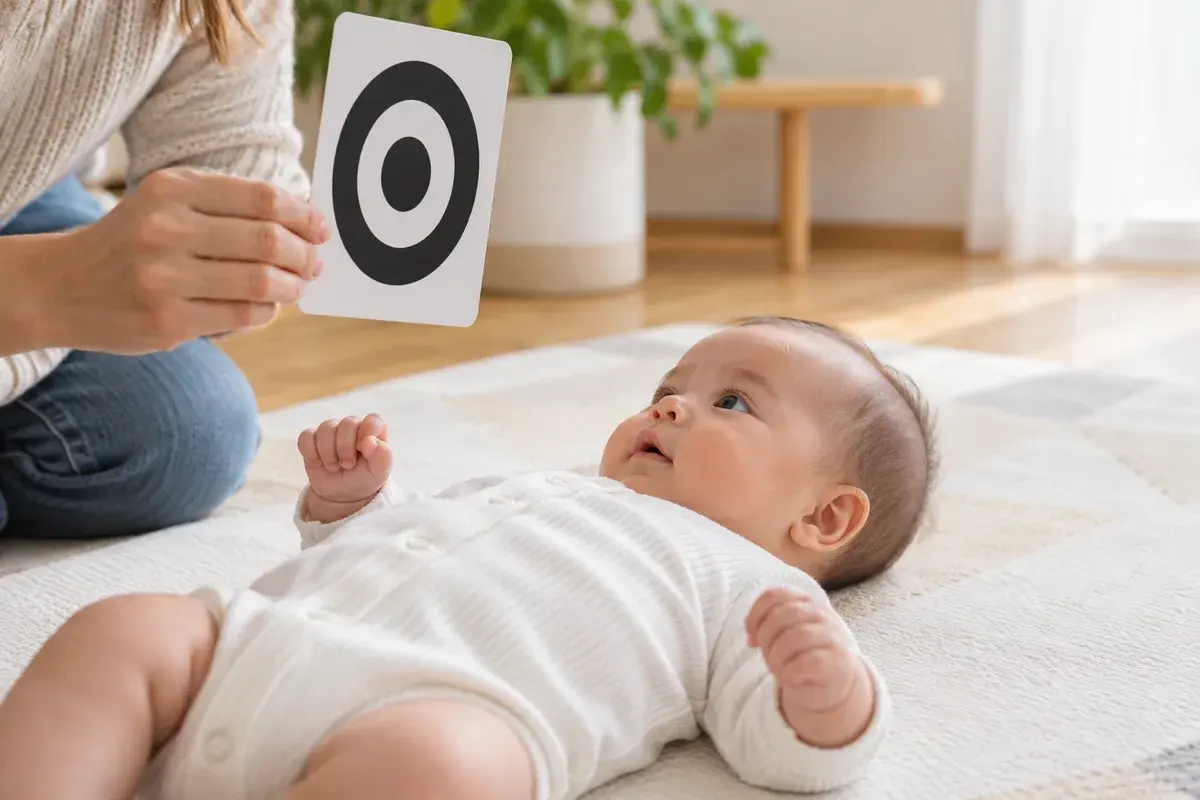
Black-and-white cards work best as a small, supervised visual-play moment—not as a lesson your baby has to complete. Start when your newborn is awake and calm, hold one card about 20–30 cm from their face, keep it still for a few seconds, and move it slowly only if they are already looking at it.
There is no required daily score. A few calm seconds can be enough. Stop when your baby looks away, yawns, closes their eyes, becomes fussy, or seems ready for a feed or a cuddle. The goal is shared attention, not proving that a card caused a developmental milestone.
- Use one simple card at a time.
- Hold it close enough to see, but never against the baby’s face.
- Let the baby set the pace.
- Keep cards out of the sleep space and away from unsupervised mouthing.
Why distance and contrast may help
Newborn vision is still developing. The American Academy of Pediatrics describes a newborn’s clearest near range as roughly 8–12 inches, or about 20–30 cm—the distance between a baby’s face and a caregiver during a feed. Young infants may study black-and-white or sharply contrasting patterns because the edges are easier to notice than a busy image with many similar colors.
That does not mean newborns see only black and white, and it does not mean every baby will prefer a contrast card. Some babies will watch a face, a window edge, or a caregiver’s voice instead. A card is simply one optional visual focus that can make a short interaction easier to begin.
FREE PRINTABLE RESOURCE
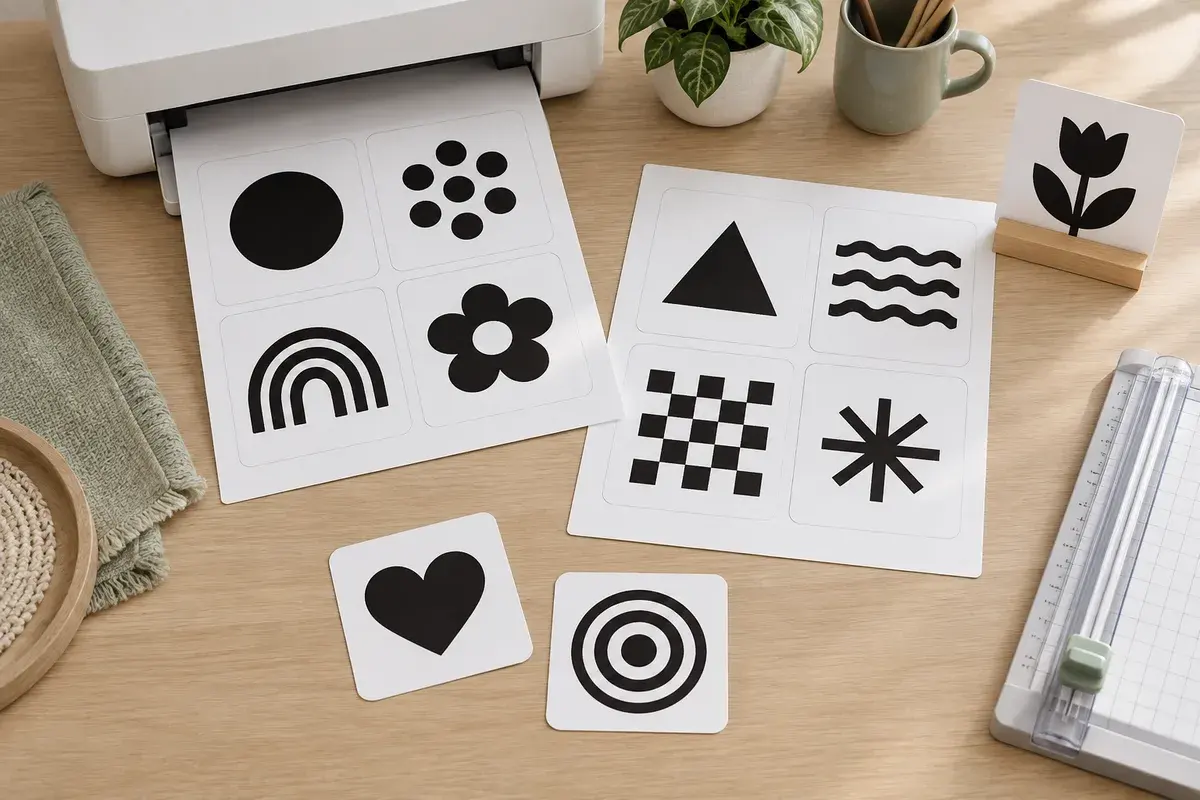
Choose a few cards for today
Browse a free library of high-contrast black-and-white cards, organized for newborns and young infants. Start with one simple pattern and follow your baby’s cues.
Set up a calm moment first
Choose a time when the baby is awake, comfortable, and not already showing strong hunger or tiredness cues. A clean floor mat or another firm, stable activity surface works better than a soft couch or an improvised sleep area. Keep the light comfortable and avoid glare on the card.
Use a card with a clear shape and a clean edge. If you printed it yourself, smooth the corners and remove scraps before bringing it near the baby. The adult should hold the card throughout the activity. A paper card is not a chew toy, a mobile, or a sleep product.
- Choose one large circle, stripe, checkerboard, or similarly simple pattern.
- Keep scissors, clips, strings, and paper scraps away from the activity area.
- If the baby is on their tummy, stay close and supervise the entire time.
- If the baby becomes sleepy, end the activity and move to the family’s safe-sleep routine.
Use a slow three-step rhythm
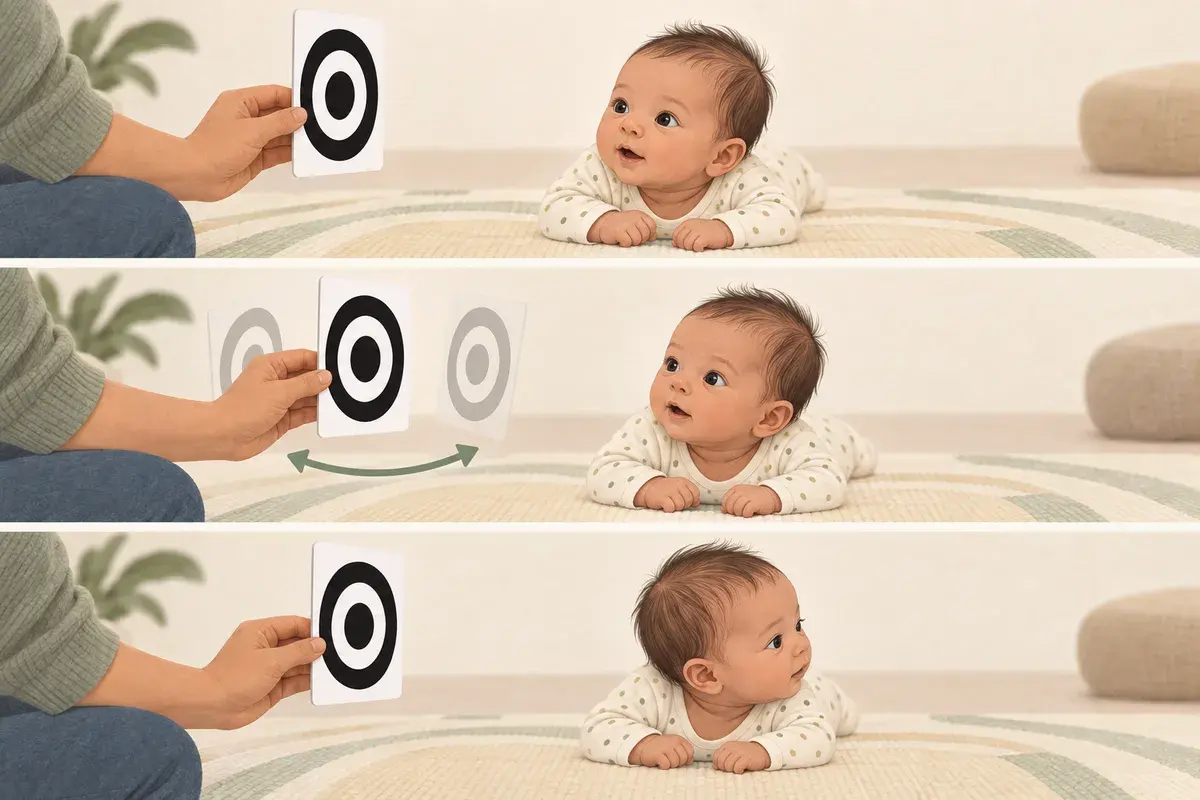
First, hold the card still in front of the baby. Give them time to find it; a newborn may need several seconds before their eyes settle on a new object. If they look at it, keep your hand steady rather than immediately waving the card around.
Second, try a slow movement from the middle toward one side and back again. Keep the card at roughly the same distance and use one smooth path. Third, pause when the baby loses interest. You can return to a still card once, but you do not need to chase their eyes around the room.
- Still first.
- Slow movement second.
- A pause or cuddle when the baby looks away.
- A different card only if the baby remains comfortable and interested.
How long should a newborn look at a card?
Start with a brief attempt: a few seconds to a minute is plenty for a very young newborn, and 1–3 minutes can be a practical upper starting point when the baby is calm and engaged. These are not medical limits or a target to hit. Some days the interaction will be shorter; some days the baby will want to look at your face instead.
Do not keep going because a timer says the session is unfinished. A quiet, responsive adult is more useful than a longer display. If the baby is still interested, you can switch to a second card or add a soft sentence about what they are seeing.
- Newborn: start with seconds, not a performance-length session.
- Older infant: follow interest rather than automatically extending the time.
- End before the baby is overtired or upset.
- Short, repeatable moments are easier to fit into real care routines.
Follow the baby’s cues
A baby who is ready may look toward the card, stay relatively relaxed, or briefly follow it with their eyes. You can narrate gently—“a circle,” “black and white,” or simply “I see you looking”—without asking the baby to perform or respond.
A baby who needs a break may turn their head, look past the card, blink more often, yawn, arch or stiffen, frown, fuss, or close their eyes. Treat those signs as useful communication. Put the card away, lower the stimulation, and return to feeding, holding, or quiet time.
- Interest is an invitation, not a promise to continue.
- Looking away is a valid answer.
- A baby who is not interested has not failed the activity.
- Ask a clinician about persistent visual concerns rather than testing with more cards.
Keep the activity safe
Use cards only during awake, supervised activity. Do not attach them to a crib, hang them over a sleeping baby, or leave them on a sleep surface. The CDC’s safe-sleep guidance recommends a firm, flat sleep surface and a clear sleep area; a paper card belongs in a supervised play moment, not in the sleep space.
As babies begin to reach and mouth objects, supervision matters even more. Take the card away if it is being grabbed, torn, chewed, or pulled toward the mouth. Discard cards with sharp edges, loose laminate, paper flakes, or other damage.
- Adult holds the card; baby does not use it independently.
- No card, stand, string, clip, or loose paper in the crib or bassinet.
- Use a safe, stable surface for awake play.
- Follow your own pediatrician’s advice if your baby was premature or has a health condition.
QUICK ANSWERS
Questions new dads ask
Can newborns see black-and-white cards?
Newborns can detect light, shapes, faces, and movement, and some young infants show interest in sharply contrasting patterns. They do not see only black and white, and a card is not a vision test.
How far should a black-and-white card be from a newborn?
Start around 20–30 cm, or 8–12 inches, which is a typical clear near range for a newborn. Adjust for comfort and never press the card close to the face.
Can black-and-white cards improve a baby’s eyesight?
They should be treated as optional visual-play materials, not treatment. They cannot diagnose a problem, guarantee development, or replace routine pediatric and eye care.
SOURCES
Read the primary guidance
Health and safety notes are summaries for general education. Follow your own care team’s advice.
Edited by the newdadatlas editorial desk. We write for general education and link to primary guidance; when a question is personal, urgent, or medical, contact a qualified professional.